For the 150th anniversary of the Bayreuth Festival, the special production “10010110 — From Myth to Code” made artificial intelligence an image-generating force on stage. The system recombined a century and a half of performance history across enormous screens while singers and orchestra carried Wagner’s Ring. The result was technically ambitious, visually restless and deliberately experimental—and it exposed a central question for every creative AI tool: who is responsible for meaning?
- What the production actually did
- The audience response was more complicated than the headline
- Generation is not the same as direction
- The lesson for creative AI products
- The VerdictLab view
What the production actually did
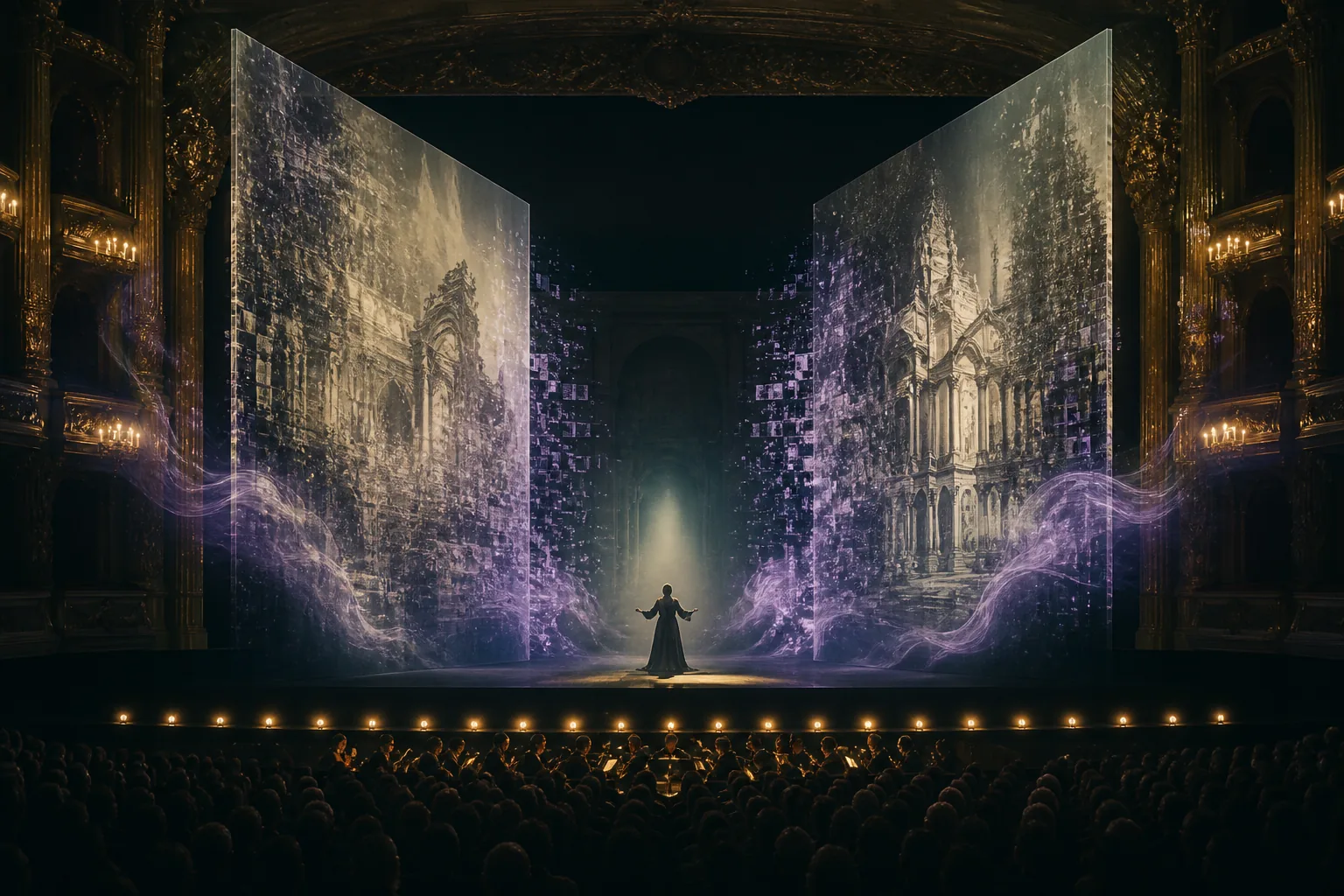
According to the festival and Associated Press, the team worked with about 1,000 images from earlier Bayreuth Ring productions and combined roughly a dozen AI models. Stable Diffusion began each act from scenery associated with the 1876 premiere, while software selected and transformed imagery in relation to text and music. Singers stood between two vast projection surfaces, making live bodies the fixed point inside a constantly changing visual archive.
The audience response was more complicated than the headline
Boos and whistles greeted the production team, but the performance did not simply collapse. AP reported a 17-minute ovation for conductor Christian Thielemann and the cast, with a shorter burst of protest when the visual team appeared. Bayreuth has a history of controversial premieres later being reassessed, so one evening cannot settle the artistic verdict. It can, however, reveal what the audience felt was missing.
Generation is not the same as direction
The team openly described the work as an experiment rather than a conventional stage direction. That distinction matters. A model can retrieve, combine and vary thousands of references, but drama depends on hierarchy: what the audience should notice, why one image follows another, how a body changes a scene and when the stage should become quiet. Without a strong organizing intention, abundance can feel like motion without consequence.
The lesson for creative AI products
The same problem appears in image, video and presentation tools. More generations do not automatically create a stronger story. Useful systems need continuity, revision controls, provenance and a workflow that lets a person reject attractive but irrelevant output. A creative tool earns trust when it strengthens the author’s decisions, not when it hides those decisions beneath endless variation.
The VerdictLab view
Bayreuth’s experiment is valuable precisely because it did not produce a simple triumph. It tested AI at cultural scale, in front of an audience that knew the material, and made the limits visible. The fairest conclusion is neither that machines cannot belong on stage nor that spectacle proves artistic intelligence. AI was an unusually large instrument; the human task of giving that instrument purpose remained decisive.
AI can multiply references at extraordinary speed; it still needs a human point of view to turn those references into drama.
VerdictLab editorial note
Original sources
This VerdictLab report is an original summary and analysis based on the reporting below.
How this was created: VerdictLab selected and checked the cited reporting, prepared an original summary with AI assistance, and translated it for accessibility. We link to the original publishers and do not reproduce their articles.